
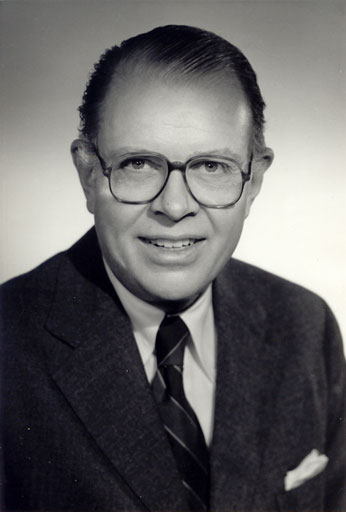
Richard C. Cornelison, BSEE
July 24, 1926—March 25, 2004
An inquiring mind and loving spirit
(A short version of this obituary is also available.)
Richard Cleveland Cornelison, inventor, entrepreneur, civic hero, rebuilder of a pioneering educational institution and lover of nature and people, died suddenly of a heart attack in the early morning of March 25, 2004. He was 77. He died in Smithers, British Columbia where he was planning to move with his wife, Kathleen Ruff.
Few people have crowded into 77 years so much of living, of achievement, of service to their fellow men as Dick Cornelison. He was a loving husband, parent and grandparent, and he touched the lives of many others, inspiring their love and admiration. In their words…
“He was a gentleman, an adventurer, a sage, a mentor, and an absolutely wonderful person.”
“I still find myself thinking, ‘How would Dick respond?’”
“A more rewarding and productive relationship I have never experienced outside our home.”
“Dick led the charge, but never sought personal recognition for the accomplishments of the team.”
His death shocked many, because though he was the most serious and responsible of adults, he never lost the ebullient enthusiasm of youth. He loved Google and the riches of the Internet it opened up for one who retained the curiosity of the young.
Dick was the son of Eben and Ella Cornelison, who lived in Salt Lake City, Utah their entire adult life—having met in college in Wisconsin. For Dick’s first 16 summers, from the date of his birth on July 24, 1926, he and his mother lived in Wisconsin with her parents while Eben, a salesperson of paper products who worked for the same company his entire career, was on the road selling. The Great Depression had a great impact on Dick who ever since was highly motivated to achieve.
Dick’s was an active childhood. The many interests he pursued as child and youth presaged his adult life. Dick started taking flute lessons at age 8 and at 12 was first flutist for the nascent Salt Lake City Symphony. He listened to Glenn Miller on the radio and played his records—String of Pearls, Kalamazoo—on a wind-up Victrola. As an adult, he loved classical music—and especially anything by Bach. “The elegance and tenderness of Chopin touched his heart”; music was a huge part of his life.
An insatiable curiosity and desire to be about things and to take the lead in doing them marked his adult life. As a child, he was a collector—of minerals, stamps, and electrical and electronic gear. In school, he “loved physics and chemistry and … tolerated most of the other subjects.” He was president of his junior high school student body. He said that he “was sort of a natural leader in school because I was tall and my parents had taught me how to deal with people.” Despite being tall—he listed himself at 6-2 and 155 pounds in his college application—he “wasn’t so good at basketball.” He was better at track and wrestling but did not pursue competitive athletics in high school.
For the younger Cornelison, the out-of-doors beckoned on weekends and during vacations—hiking when the weather was good, skiing in the winter. The adult Cornelison relished being outdoors and dedicated himself to the protection of the natural environment against human despoliation. He loved improving the land he lived on; ensuring future owners would continue the stewardship. He often walked to work and was an avid backpacker. The entrepreneurial designer and builder of later years can be seen in the special pride that the young Cornelison took in an eight-foot dinghy that he built himself. He included a picture of it in his college application.
As a youth, Dick learned the stern habits of work. He first worked at a nearby Safeway. Then, when in high school he worked at the arsenal in nearby Ogden, loading tank parts on railroad cars. It was heavy work, it contributed to what was by then the war effort, and he “made a lot of money”—at least compared with his Safeway job at 45 cents an hour.
The college application that included the picture of his dinghy was to Deep Springs, a prestigious junior college, located just north of Death Valley in an isolated desert valley east of the Sierra Nevada. There two dozen or so young men engage in rigorous academic studies, work on and about the cattle ranch that is the Deep Springs campus, and govern themselves and contribute to the management of the institution in a way that has no parallel in American higher education. The objective is to prepare these “promising young men,” the founder’s term for them, for lives of leadership and service.
Dick’s B+ high-school average plus his activities (not mentioned above is the fact that, in addition to all else, he was a Life Scout) gained him admission to Deep Springs in 1943. This was immediately fortunate for him. All Deep Springs students are there on complete tuition and board-and-room scholarships, and Dick did not think his family had the money to send him to college. In the longer term, as will be seen, Dick’s acceptance and the year he spent there were most fortunate for Deep Springs.
Dick was able to spend only one year of the customary two at Deep Springs because of the war. He would turn 18, the World War II draft age, in 1944, the summer after his first year. It was a crowded year. Besides his academics, Dick, in turn, was in charge of the vegetable garden, milked the cows that provided the community with its milk, cream and butter, and, by the election of his fellows, served as labor commissioner, the most demanding and therefore most prized student body office. Many of his deepest and most rewarding friendships stem from these days.
Leaving Deep Springs, Dick was accepted into the Navy’s V-12 officer training program and was sent to Colorado College in 1944. The war over before he saw any action, Dick entered Cornell University in October 1945. Here he met his future wife, Margaret Eleanor Hawkins, who attended Wells. He graduated in June 1948 with a Bachelor of Science in Electrical Engineering degree.
Dick began the pursuit of his chosen profession in the heady days that followed World War II, when the future was bright for a generation that had grown up in the prolonged depression of the thirties and had fought a war to save the world from a murderous tyranny. His first long-term employer was General Electric; for a year, he was a test engineer in Erie, Pennsylvania, then Lynn, Massachusetts. He was selected by International General Electric for its electrical engineering training program and moved to Schenectady. Margie joined Dick there after their marriage a few months later, in 1949.
They moved to San Francisco in March 1951, to work for a subsidiary of the old Standard Oil Company of California as a systems engineer. Working on the design of the Materials Test Accelerator, the young family—now with their first son Peter—moved across the bay once construction began on the cyclotron—one of the first key projects at Lawrence Livermore National Laboratory.
After that, it was back to Colorado Springs, where, from April 1953 to September 1954, Dick worked for Universal Electric Western Company. It was his first experience with fractional horsepower motors. As it turned out, small motors were to be the center of his working life for the following 13 years. While in Colorado Springs, he received a telephone call from the father of his Deep Springs friend Pete MacDonald, inviting him to consider a job with Lamb Electric in Kent, Ohio, the caller’s employer. Initially unsure, the claim that he might potentially make twice what he was making in Colorado Springs at least piqued Dick’s interest! Dick joined Lamb, which, by an acquisition, would become AMETEK-Lamb Electric and remains a manufacturer of small motors, for 12 years, much of the time on the road selling, and ending as the general sales manager.
Between 1954 and 1958 two daughters and a second son were born. Margie helped Dick refine his social skills, and as a student of art history, honed his aesthetic sense. An expression of this was Dick’s venture into woodworking. With the help of his father-in-law, he built numerous pieces of furniture.
The growing family was on the move a good deal in the early years of the marriage. From Schenectady to three houses in the San Francisco Bay Area, to Colorado Springs, to Kent, they finally settled for ten years in nearby Chagrin Falls. There Dick experimented with bee keeping (a profession of his grandfather’s), making wine and contemplating inventions such as automatic pill counters and butter cutters.
The family moved to Hudson, Ohio, in 1965 and a few years later purchased a cabin near Little Valley, New York, with family friends. This was ski country, and the purchase made it possible for Dick again to enjoy his love of skiing, the techniques of which he happily taught the other adults and the children.
In the summer of 1966, Dick joined Milbar Corporation, a manufacturer of small hand tools, located initially in Cleveland, then in Chagrin Falls. He became the general manager of this rapidly growing company and was a key factor in its early success.
Dick had moved to rural Hiram, Ohio, in 1972 after separating from Margie. At the end of 1973, Dick married Priscilla Jean Putnam. A social progressive, she earned her livelihood as a piano teacher and her zeal for music revived Dick’s interest in playing flute. They played duets and performed with others frequently—it became their primary form of relaxation and created firm bonds with those in the Hiram community.
In Hiram, Dick fulfilled the ambition of being his own boss. Always inventive, he received the first of his 22 patents, on a heat exchange enhancement structure, in 1980. In 1981, he founded and for the first few years ran the Condar Company, manufacturer of energy saving and safety devices for wood stoves, including the magnetic stovepipe thermometer, Dick’s invention, seen on millions of wood stoves today. In 1986, he transferred the company to his elder son Peter and his wife. It is still in business.
He had a plant built for Condar in Hiram, providing local employment and contributing to the quality of the life of his community with a native wildflower garden that he had laid out around the plant.
Dick divested himself of Condar to found the Camet Company, a developer and manufacturer of catalytic converters. Two experts joined Dick in developing converters that used a specialized stainless steel substrate instead of ceramic, Dick’s sixth patent, which markedly improved catalytic performance and thus reduced air pollution. Dick managed the R&D efforts, was the principal salesperson, and was responsible for developing the new manufacturing techniques needed to produce the product.
Early in its life, Camet sold its patented technology to W.R. Grace & Company, and Dick managed the concern for Grace under an operating contract while continuing to develop new products. In 1993, Grace purchased Camet outright. (Engelhard Corporation has since acquired it.)
Dick “retired” in 1993 after the sale and began attending to Priscilla, just diagnosed with cancer. Their battle ended with her death in July 1995.
Then, for the next three years, Dick worked with his stepson, David Michael, a Chemistry Ph.D., marketing his molecular modeling software for chemists, ChemSite.
In 1998, he moved from Hiram to Boulder to be closer to his children and grandchildren.
He returned to the world of manufacturing in 2001, when he was nearing 75. With four former business partners, Dick started a new development company called Catacel Corporation. Building on Camet’s converter business, Catacel undertook the development of a catalytic combustor for large turbines. Later the company shifted its primary emphasis to developing a fuel reformer for the fuel cell industry. It continues to pursue that goal, as well as working on developing a fuel reformer for commercial reformation and heat exchangers for fuel reformers. Dick chaired Catacel until his death.
Still less did the 1993 retirement mark the end of Dick’s endeavors in the service of the public good. In 1989, he became a member of the Board of Visitors of Duke University School of Forestry and Environmental Studies—and later the Board of Visitors for the Nicholas School of the Environment and Earth Sciences. Fellowship of the Washington Duke Club was awarded Dick in recognition of his service to the School.
In 1992 Deep Springs called upon one of its most successful and public-spirited alumni to become a trustee. It was a time of crisis for the college. It had celebrated its 75th anniversary that year, but its continued survival was in doubt. The endowment was small and being eaten away by recurrent annual deficits. The physical plant, much of it dating back to the founding in 1917, was crumbling. Dick accepted the challenge.
Joining the Board in 1993, he became its chair in 1995 and promptly took the lead in undertaking a staggeringly ambitious capital campaign. It succeeded; in the end, $18 million was raised—twice the original goal for an institution with perhaps 600 living alumni whose whereabouts were known, an alumni body about the size of a single graduating class of a small liberal-arts college. The physical plant was rebuilt, and the endowment grew. The vision was Dick’s and so was much of the energy expended to make the vision a reality. For his efforts, at the conclusion of his trusteeship, he received the Deep Springs Medal, only the fifth person so honored.
In 1999, while traveling in the Canadian Rockies, he met Kathleen Ruff, an avid outdoors person and social activist, who also had lost a spouse to cancer. They were married in 2001 and just last fall moved to a townhouse in nearby Estes Park. Ultimately, they planned to move to Smithers, British Columbia where Kathleen owns a house.
In the last year it finally could be said Dick was finally relaxing, taking a portrait-drawing class and was going to go on to watercolors. Dick continued working on his investing strategies, but had more time to exercise, got more involved in politics, and loved staying in touch with his friends.
The number of lives Dick touched was phenomenal. His concern and compassion for others was life altering and Dick was a key mentor for many people. It has been said repeatedly that Dick, “believed in me and inspired me to be more than I thought possible.”
Dick’s inquiring mind and loving spirit will always be sadly missed and tenderly remembered by his wife and descendants: Peter of Hood River, Oregon; Elizabeth of Santa Clarita; Anne of Boulder; and John of Vashon Island, Washington; four stepchildren and ten grandchildren.
In lieu of flowers, if you wish to make a donation in memory of Dick, please send it to the Natural Resources Defense Council or Deep Springs College. Dick’s passion to reduce air pollution and improve air quality drove much of his later professional life. NRDC actively works to improve air quality through their support of a responsible energy policy and alternative energy. Make donations online at https://www.nrdc.org/joinGive/join/honor.asp
Mail memorial gifts to: Richard C. Cornelison Memorials Natural Resources Defense Council Membership Department 40 West 20th Street New York, NY 10011
Richard C. Cornelison Memorial Endowment Deep Springs College HC72, Box 45001 Dyer, NV 89010-9803
A memorial service will be held at 9:00 am, Saturday, May 8 in Hiram, Ohio at the Hiram College Hayden Auditorium, in Bates Hall. Refer to www.cornelisons.com for detailed information on the memorial service, for more about Dick’s life, or to submit your remembrances.
Thanks to Dick’s Deep Springs classmate Bill Allen for his expert help editing this obituary.