
Dick Cornelison—A Classmate’s Memoir
I’ll never again pick up the phone to hear Cornelison, in his peremptory labor commissioner’s voice, say: “MacDonald—get over to the West check—there’s work to be done.” Nor will I find the occasion to tell him how steamed Uhlmeyer (ranch manager in 1943) is over some imagined shortcoming of his. RCC—Richard C. Cornelison—died of a heart attack March 25 in Smithers, BC, where he had moved with his wife Kathleen last fall.
I first met Dick in the wartime summer of 1943 when we entered Deep Springs Jr. College at the tender ages of 16 and 17. Student Body Labor Commissioner Al Votaw assigned Dick to work in the ranch vegetable garden; my duties as ranch feed-man included feeding the chickens and collecting eggs. The building where the chickens nested divided the vegetable garden from the yard where the chickens roamed, occasionally depositing eggs in the grass and weeds. These eggs, being of uncertain age, were considered inedible, and I made Cornelison’s acquaintance by lobbing them over the chicken-house roof at the unseen gardener. Believe it or not, this was the foundation of a lifelong friendship.
With our classmates we shared the uniquely rich experience that Deep Springs offers, including immersion in a world of intellectual challenge, for which I felt unready. Did Dick feel the same? At this distance I can’t be sure, but I believe the answer is yes. Classmate Gerry Pook remembers that senior classmate Al Votaw once joined us on a work detail pitching chopped alfalfa; while pitching, Votaw read aloud from Giraudoux’s Amphytrion 38 . (Giraudoux was not known in Milan, Ohio, High School in 1943 nor, presumably, in Salt Lake City’s East High School).
But Cornelison was more than up for the rigors and joys of living and working and hiking in the untrammeled desert and mountain worlds of Deep Springs Valley and its environs and Utah’s Wasatch Range country. A native westerner, the joy and challenge he encountered in the natural world were among the great loves of his life, and he had the constitution and temperament to meet the challenge. The personal and leadership qualities that distinguished him throughout his life were recognized early by his classmates who elected him labor commissioner, making him second-in-command to the ranch manager.
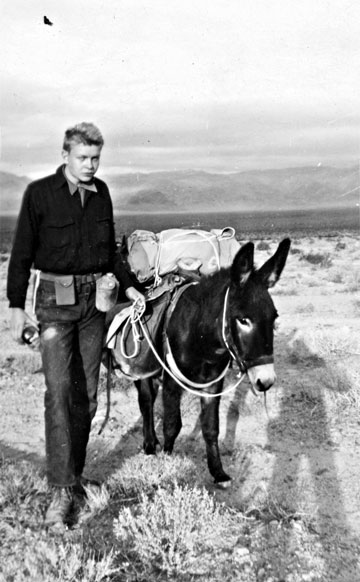
One of our favorite memories was an abortive pack trip across neighboring Eureka Valley, abortive because Babu, the ranch burro, loaded with our gear, lay down about three hours from the ranch and refused to go on. Since returning to the ranch would have been too embarrassing, we camped at Antelope Springs, ate three days supply of food, and explored an old abandoned mining claim located at the spring. Some forty years later Dick phoned me to propose that my wife and I join him and Priscilla for a week–long camping trip in the high Sierras. The companionship and the beauty of that still-unspoiled country were unforgettable. When he and Priscilla called the following winter proposing that we repeat the experience by completing the circuit we had begun the previous summer, we hesitated before agreeing, practically sure that a second experience could never match the first—but it did. The joy of those two summers is burned in my memory.
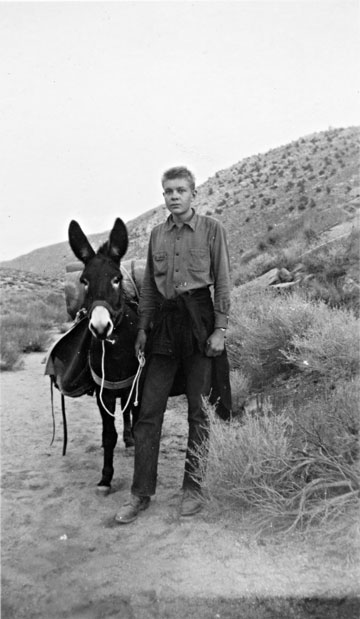
Dick and I made our last Deep Springs trip together in the spring of 1944, hitchhiking to San Francisco to apply for the Navy’s V-12 officer training program. Dick was accepted and began training at Colorado College in July. When I failed the eyesight exam, I enlisted and was assigned later to training as a torpedoman. Hitchhiking back to the ranch we got as far as a point in Fish Lake Valley from which we hoofed it over Gilbert Pass, carrying our suitcases.
The war over, Dick and classmate Henry Jameson made a fateful visit in 1946 to my home in Norwalk, Ohio; they were probably on their way west after completing their first year at Cornell. When those two big galoots joined my family at dinner, the dining-room table that had always been adequate in size for five persons of normal height got lifted off the floor by their long legs. It’s a MacDonald family joke that my father decided that day to replace the table. In 1949 Henry and I attended Dick’s wedding to the lovely Margie Hawkins in Tulsa. I remember Dick’s once telling me that he had spotted Margie, a complete stranger, in a hallway at Wells College and decided on the spot: “That’s the girl I’m going to marry.”
In 1954, my father, a sales engineer at the Lamb Electric Co. in Kent, Ohio, mentioned to my mother that the firm was seeking a replacement for the senior sales engineer, who was about to retire. When she reminded my father that Dick’s degree was in electrical engineering, he immediately phoned him and invited him to visit the plant to explore applying for the job. Initially disinclined to leave his test engineer’s job in Colorado Springs, Dick made the trip and was hired. (An interesting aside: Dave Laylin, the engineer whom Dick replaced, was an uncle of Jack Laylin, a former Deep Springs student and long-time dedicated trustee of the College.) Eventually becoming sales manager, Dick remained at Lamb until l966 when he was hired as sales manager at Milbar Corp. in Cleveland, a small company that manufactured specialty tools. I still have a pair of Milbar electrician’s insulation-cutting pliers which Dick gave me.
With his departure from Milbar in 1981, he began what I believe was the most fruitful period of his professional life, beginning with the invention and marketing of small energy-saving and safety devices for wood stoves. He gave me one of these early products which is still in use on a friend’s wood stove in Lyme, NH. Over the next decade, with the technical input of several colleagues, he developed and patented a catalytic converter, a device for reducing pollutants emitted by internal combustion engines. At the same time, he conceived and established the firm he called Camet to manufacture the converters. During visits and conversations with him and Priscilla at, initially, their ramshackle old farmhouse outside Hiram, Ohio, I learned how they struggled financially at the outset. The bank that loaned the funds to develop the converter and to finance building the plant kept pressing Dick until he was able finally to demonstrate commercial viability. I know this was a constant worry. Surely this is Dick’s major professional achievement, one in which he called upon his engineering training and business background, his inventor’s gift, his dedication to the cause of protecting the environment, and just plain grit I know he was proud of inventing a device which reduces pollution at a lesser cost than competing products, and of the modern plant with manufacturing techniques of his design, but in a tour of the plant we made together he was too modest to crow about his success.
Beginning in 1992, when he became a member of the Board of Trustees of Deep Springs College, later Board chairman, my classmate repaid a hundredfold the debt to the College which all alumni owe: classmates Bill Cowan and former trustee Bill Allen both credit Dick’s leadership and vision with revitalizing the College at a time when its future was in jeopardy. With Dick leading the drive, the College’s aging physical plant has been replaced, restored, and expanded, and the endowment has been replenished. I can’t count the number of money-raising trips I know he made around the country, or the hours devoted to Board and other meetings—he was indefatigable once he set his mind on a goal.
A third legacy follows from his caring and readiness to take younger members of his family “under his wing” (in his son John’s words). With Dick this went beyond simple parental duty. I remember his taking a step-grandchild on a trip to Europe when, if I recall correctly, he felt the lad needed a grandfather’s guidance. I remember his contributing substantial time and personal funds without assurance of return to a project in collaboration with Priscilla’s son David. And I know from conversations and observation over the years that he was always there through thick and thin for his own children into their adult years.
In my last phone conversation with him at Christmas time he told me that he had adapted happily to his new life in Canada with Kathleen, and that he was enjoying the people in Smithers and the pace of life there.
In writing these lines I learn with new sharpness how much I love and admire him, and how much I will miss him.
Oh rare Dick Cornelison.
Pete MacDonald May 3, 2004